Friday, December 9th, 2011
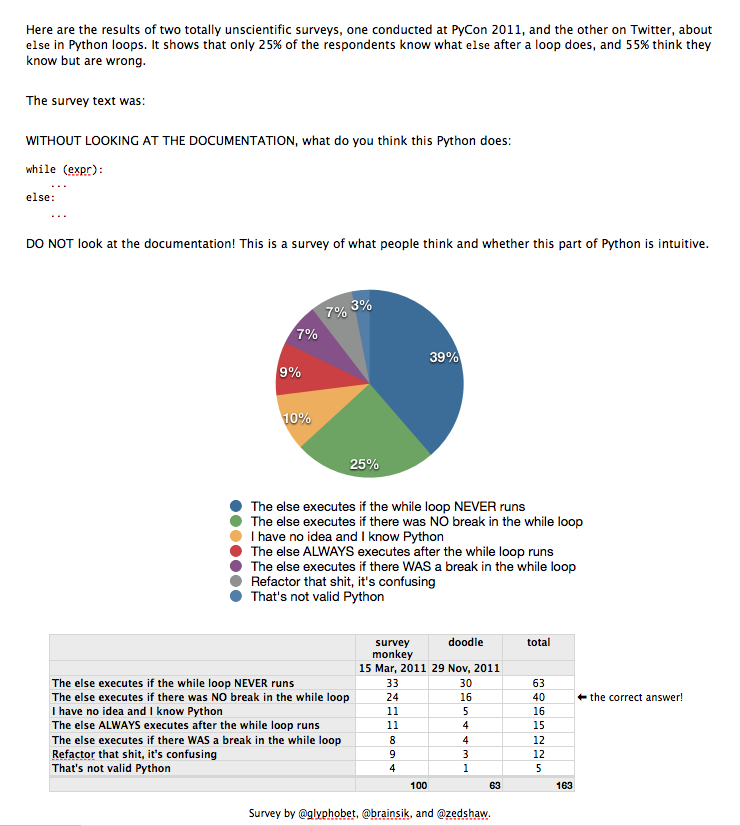
As promised, here are the results of two totally unscientific surveys, one conducted at PyCon 2011 and the other over Twitter just a few days ago, about the behavior of else in Python loops. The results show that only 25% of respondents know what else in a Python loop actually does, and 55% think they know but are wrong.

Monday, June 27th, 2011
The Mathematician’s Dice are now for sale to the general public!

The Kickstarter project to get these dice to market was an amazing experience. I plan to write the whole thing up and post it here soon.
Tuesday, May 10th, 2011
Here’s a little gist that I wrote to illustrate the difference between MongoDB‘s use of degrees vs. radians in its non-spherical and spherical geospatial queries:
Monday, March 21st, 2011
I’ve already tweeted about this, but for all you Python programmers who have gotten indigestion from the complex process of installing virtualenv and virtualenvwrapper, check out brainsik’s virtualenv-burrito. It wraps up both tools and installs them for you in a single step, no thinking required.
Monday, January 24th, 2011
A while ago I designed the Mathematician’s Dice (on Shapeways), dice with i, 0, 1, φ, e and π on them. Now I’ve launched a Kickstarter project to get a run mass produced! Check it out, and donate or pass it on to friends:
Saturday, December 11th, 2010
I am going traveling very soon, so things will get pretty quiet around here. My posts here are split up into three categories, and each has a separate feed:
- Essays (subscribe here), my longer, in-depth writings, usually about technical subjects.
- Travelog (subscribe here), which is where I have written about my travels. Although will be traveling soon, I’m not sure if I’ll continue to write travel log entries.
- Blurbs (subscribe here), mostly links to things I find interesting, with very short commentary. For the last few months I’ve been posting interesting links & short commentary via Twitter instead, so if you like my blurbs, or want to respond to anything on here, you could follow me on Twitter.
There’s of course also a master feed for all posts. You can follow my posts on Digg, or follow my account on the awesome soup.io, which aggregates this blog, and my twitter, t-shirts, 3-d printing, and various other online presences. (Update 2011 April 6: Digg has removed import by RSS)
Sunday, December 5th, 2010
Tuesday, November 23rd, 2010
The answers to Richard Thaler’s Edge 333 question are all worth reading, but Nicholas G. Carr’s thoughts about metaphors for the brain is especially good:
I think it’s particularly fascinating to look at how scientific beliefs about the functioning of the human brain have progressed through a long series of misconceptions.
Aristotle couldn’t believe that the brain, an inert grey mass, could have anything to do with thought; he assumed that the heart, hot and pulsing, must be the source of cognition, and that the brain’s function was simply to cool the blood.
Descartes assumed that the brain, with its aperture-like “cavities and pores,” was, along with the heart, part of an elaborate hydraulic system that controlled the flow of “animal spirits” through the “pipes” of the nerves. More recently, there was a longstanding belief that the cellular structure of the brain was essentially fixed by the time a person hit the age of 20 or so; we now know, through a few decades’ worth of neuroplasticity research, that even the adult brain is quite malleable, adapting continually to shifts in circumstances and behavior.
Even more recently there’s been a popular conception of the brain as a set of computing modules running, essentially, genetically determined software programs, an idea that is now also being chipped away by new research. Many of these misconceptions can be traced back to the metaphors human beings have used to understand themselves and the world (as Robert Martensen has described in his book The Brain Takes Shape).
Descartes’ mechanistic “clockwork” metaphor for explaining existence underpinned his hydraulic brain system and also influenced our more recent conception of the brain as a system of fixed and unchanging parts.
Contemporary models of the brain’s functioning draw on the popular metaphorical connection between the brain and the digital computer. My sense is that many scientific misconceptions have their roots in the dominant metaphors of the time. Metaphors are powerful explanatory tools, but they also tend to mislead by oversimplifying.
What other contemporary metaphors are misleading us about our world today?
Friday, November 19th, 2010
Too obscure for a t-shirt, but the idea struck me and I couldn’t resist: